
06-10-2026
5 minute read
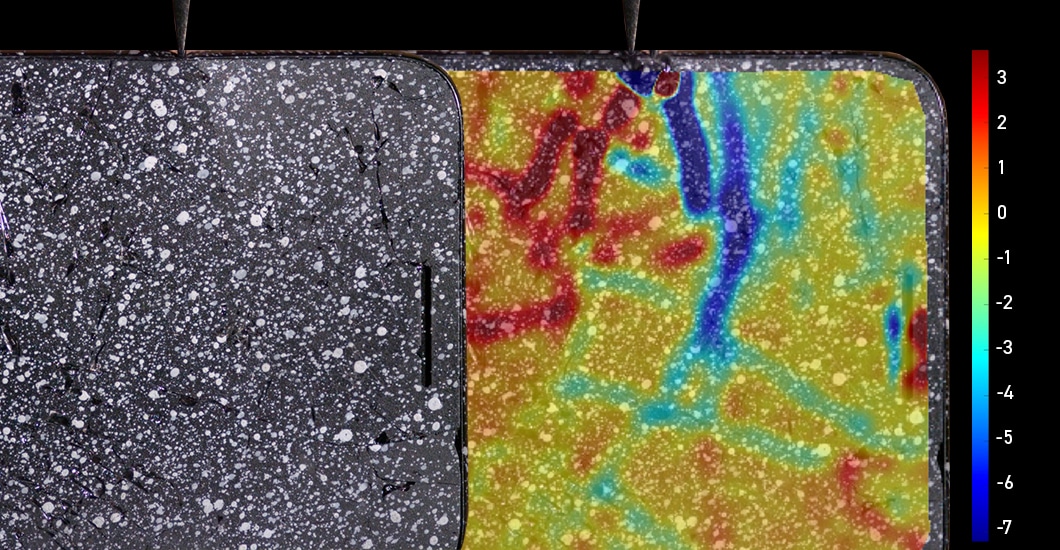
Understanding how materials behave under real-world conditions is essential in engineering, research and product development. Whether evaluating the strength of a composite structure, validating a simulation model or analysing a new design, accurate deformation measurements are critical.
Digital Image Correlation (DIC) has become one of the most powerful optical measurement techniques for these applications. Combined with high-speed imaging, DIC enables engineers and researchers to measure displacement, strain and deformation across an entire surface with exceptional accuracy—all without touching the test specimen.
At CN Rood, we support Digital Image Correlation applications with high-speed imaging solutions from Vision Research, Kron Technologies and Mercury DIC, providing complete workflows for both laboratory and industrial testing.
Digital Image Correlation is a non-contact optical measurement technique that tracks the movement of a random speckle pattern applied to the surface of a test object. By comparing images captured before and during loading, specialised software calculates how every part of the surface moves and deforms.
Unlike traditional strain gauges or displacement sensors, which only provide measurements at specific locations, DIC delivers full-field data. Every visible point on the specimen contributes to the analysis, providing a complete picture of material behaviour.
Depending on the camera configuration, DIC can be performed in:
Many engineering events occur too quickly for conventional cameras to capture. Impact testing, crack propagation, drop tests, vibration analysis and material failure can take place within milliseconds or even microseconds.
High-speed cameras record thousands to millions of frames per second, preserving every stage of these fast processes. When synchronised with DIC software, each recorded frame becomes a precise measurement point, allowing engineers to analyse dynamic behaviour frame by frame.
Systems from Vision Research and Kron Technologies are widely used in high-speed imaging applications, providing the frame rates, image quality and synchronisation accuracy required for reliable DIC analysis.
This combination provides insights that would otherwise remain invisible, making it possible to study:
A typical DIC workflow consists of several steps:
Modern software platforms such as Mercury DIC process these image sequences to generate highly accurate full-field displacement and strain measurements, enabling detailed analysis of both static and dynamic tests.
Because the measurements are optical, no sensors influence the behaviour of the specimen, making DIC especially valuable for delicate, flexible or highly dynamic materials.
Compared with conventional contact-based measurement techniques, Digital Image Correlation offers several important benefits:
These advantages make DIC particularly valuable for validating finite element analysis (FEA), investigating failure mechanisms and optimising product designs.
Digital Image Correlation is widely used across research laboratories, universities and industrial test facilities.
Typical applications include:
High-speed imaging provides the temporal resolution needed to capture extremely fast events, while DIC software converts those image sequences into quantitative engineering data.
The result is far more than slow-motion video. Engineers obtain accurate measurements of displacement, strain, velocity and deformation over time, allowing them to better understand how materials and structures respond under dynamic loading conditions.
Together, high-speed cameras from Vision Research and Kron Technologies, combined with Mercury DIC analysis software, provide a powerful solution for experimental mechanics, product development and validation testing.
CN Rood supplies complete Digital Image Correlation solutions, from high-speed cameras and optics to synchronisation, lighting and DIC software. As an authorised distributor of Vision Research, Kron Technologies and Mercury DIC, we help customers select the right combination of hardware and software for their specific measurement challenges.
Whether your application involves high-speed impact testing, vibration analysis, materials research or structural validation, our specialists can support the implementation of a reliable, accurate and scalable DIC solution.
06-10-2026
23-09-2026
16-09-2026
16-09-2026

Account Manager & Application Engineer

