
Structural Health Monitoring for Bridges and Buildings
The safety and reliability of bridges and buildings are essential to society. With aging infrastructure and increasing loads caused by traffic, environmental changes and urban dynamics, monitoring of structural health is becoming more important than ever. Structural Health Monitoring (SHM) provides the answer through advanced sensor technologies, data acquisition and intelligent analytics.
CN Rood and its partner Gantner Instruments play a leading role in this field. Together, they deliver state-of-the-art systems for data collection, monitoring and analysis that enable engineers to plan proactive maintenance and extend the service life of critical assets.
Why Structural Health Monitoring is Needed
Conventional maintenance approaches often rely on fixed inspection intervals, which can result in unnecessary costs or the late detection of damage. Structural degradation (such as cracking, material fatigue, or excessive vibrations) poses serious risks to both safety and availability.
With SHM, these risks are reduced by providing real-time insights into the actual condition of a structure. This makes it possible to detect irregularities early, schedule maintenance at the right time and avoid both unexpected failures and excessive costs. SHM not only improves safety but also ensures more efficient resource allocation and longer service life for critical infrastructure.
The Infrastructure Behind SHM
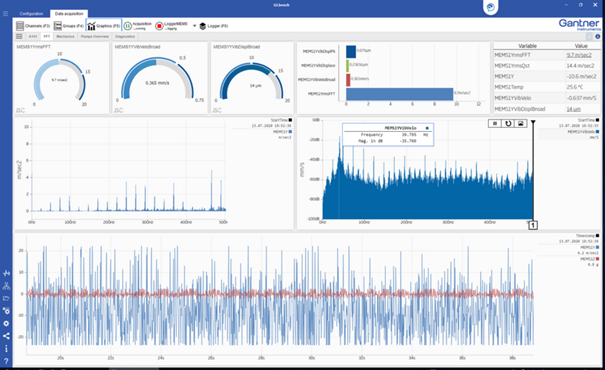
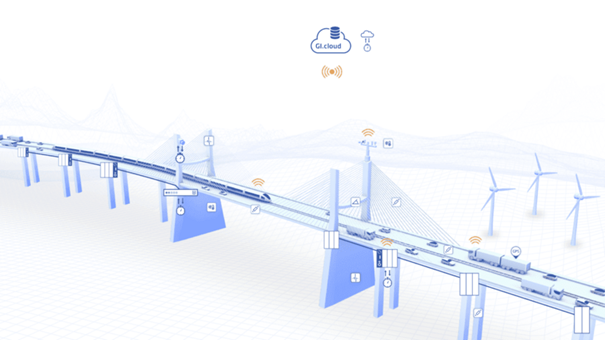
An effective SHM system integrates sensors, data acquisition hardware, communication networks, and cloud-based analytics. Sensors measure strain, vibration, displacement, temperature, and load. Data is captured and synchronized and coordinated by a central controller.
This data is securely transferred to the cloud, where real-time analysis, visualization, and automatic notifications take place. With robust networking, whether wired, wireless, or fiber optic, these systems can handle large distances and complex environments. The result is a reliable, scalable, and future-proof monitoring platform.
Case Study: Ponte 25 de Abril, Lisbon

The Ponte 25 de Abril in Lisbon is one of Europe’s longest suspension bridges. The system ensures real-time monitoring and data processing, utilizing Gantner Instruments Q.bloxx measurement modules for acquisition from over 200 sensors-strain gauges, accelerometers, displacement transducers, thermometers and anemometers. Data is processed in real time through 13 Q.station controllers connected to Gantner’s acquisition system.
Thanks to secure cloud connectivity, all data is stored and analyzed instantly, allowing engineers to detect structural degradation early and plan maintenance proactively. Technical challenges such as temperature compensation, signal noise from nearby rail traffic, and long-distance time synchronization were successfully overcome. This project highlights how advanced monitoring and analytics safeguard both the safety and the durability of large-scale civil structures.
Case Study: DB Netz, Germany
In Germany, rail infrastructure operator DB Netz uses Gantner technology to monitor a 270-meter railway bridge in real time. A Q.bloxx XL DAQ system with carrier frequency modules ensures noise-free strain and displacement measurements, supported by additional modules for universal and vibration inputs.
The system is solar-powered and operates completely off-grid in a remote outdoor location. With every passing train, data on axle count, axle load, load imbalance, vibration, and displacement is collected and transferred to GI.cloud. Automated alerts are triggered when thresholds are exceeded, preventing costly repairs. Moreover, the monitoring system can even identify train types based on speed, load, and axle configurations, offering valuable operational insights in addition to structural safety monitoring.
Conclusion
The Lisbon and DB Netz projects demonstrate how Gantner Instruments provides modular, high-performance monitoring solutions supported by secure cloud analytics. With CN Rood as its partner customers benefit from local expertise and implementation support. Together, they deliver future-ready solutions for monitoring the health of bridges, buildings, and other civil structures, ensuring safety, efficiency, and long-term reliability.