

Project
Accelerating Electric Motor Validation with NI PXI and Real-Time Test Solutions
Summary
Organisation: System integrator: CTRL engineering, End client: TRAXIAL
Challenge: Bringing real-world driving conditions into the test lab
Solution: The new test bench enables Traxial to evaluate its electric motors under representative vehicle operating conditions without requiring a complete vehicle integration.
The evolution of electric mobility is pushing the boundaries of electric motor performance, efficiency and power density. To bring new motor technologies to market, manufacturers need to validate their performance under realistic operating conditions without relying on costly and time-consuming vehicle integration.
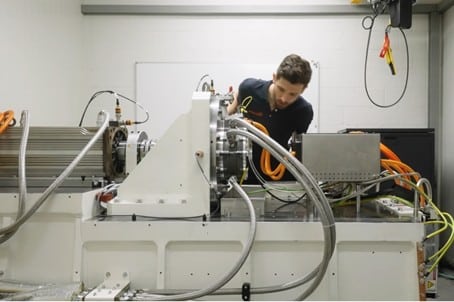
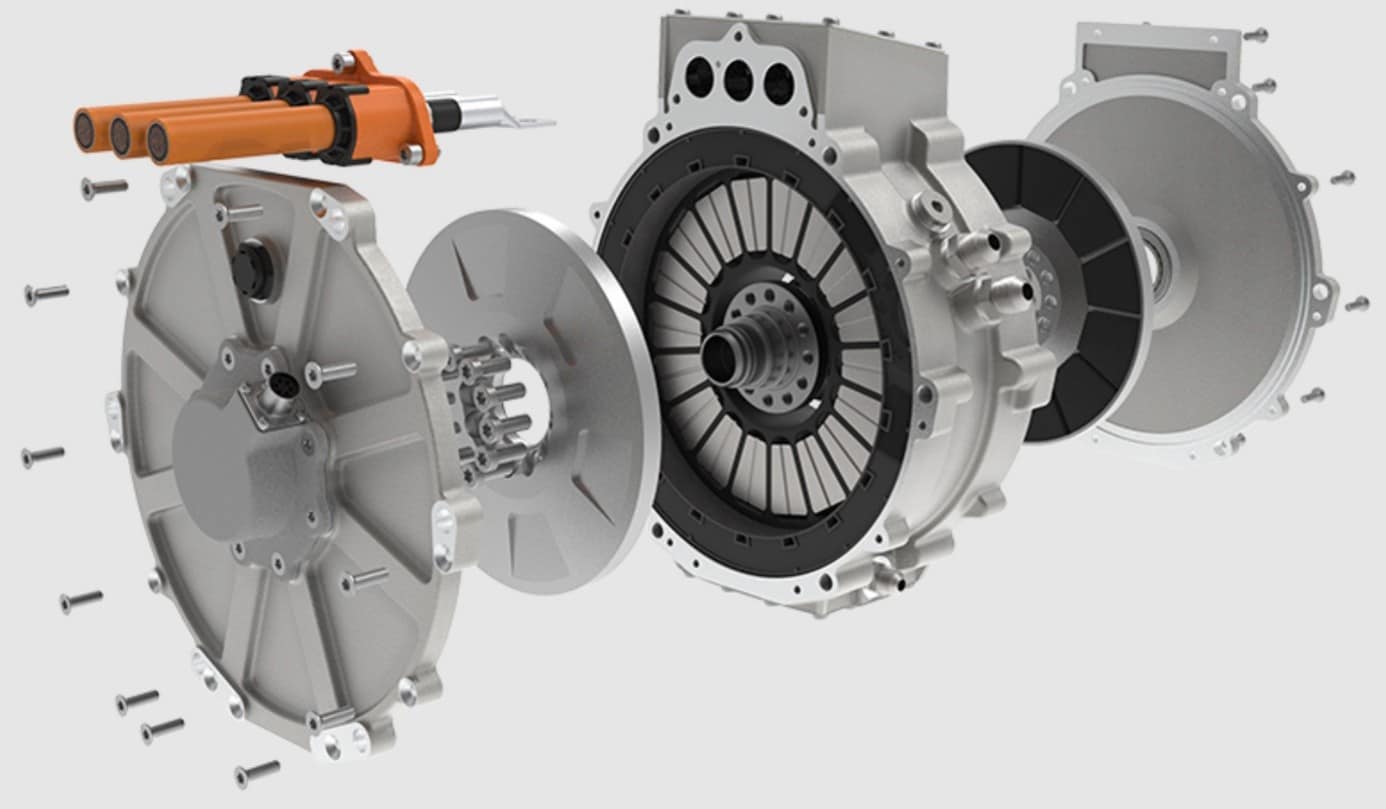
Traxial develops advanced axial flux electric motors for electric and hybrid vehicles, designed to deliver high power and torque in a compact, efficient package. To demonstrate the capabilities of its motors in real-world applications, Traxial needed a test solution capable of reproducing realistic vehicle operating conditions.
CTRL Engineering took on this challenge by upgrading a dedicated electric motor test bench. Using National Instruments (NI) hardware and software, supplied by CN Rood, CTRL Engineering created an integrated platform combining real-time simulation, motor control and automated testing.
The challenge
Bringing real-world driving conditions into the test lab
Traxial received increasing requests from customers to demonstrate how its electric motors would perform in their specific applications. However, testing individual motors without integrating them into a complete vehicle presented a challenge.
The solution needed to reproduce realistic vehicle loads while testing the physical motor under controlled conditions.
Key requirements included:
- Realistic load simulation: Reproducing vehicle behaviour through dynamic speed and torque setpoints.
- Real-time performance: Executing control models with deterministic timing to respond to changing operating conditions.
- Integrated communication: Connecting the motor inverter, drives, power analysers, sensors and cooling systems through different communication protocols.
- Automated testing: Enabling repeatable test sequences, accurate data acquisition and efficient reporting.
- Safety and reliability: Coordinating the different subsystems and ensuring safe operation in case of communication or system failures.
The objective was to move system-level testing forward, allowing Traxial to validate motor performance under representative vehicle conditions before full vehicle integration.
The solution
An integrated NI real-time platform
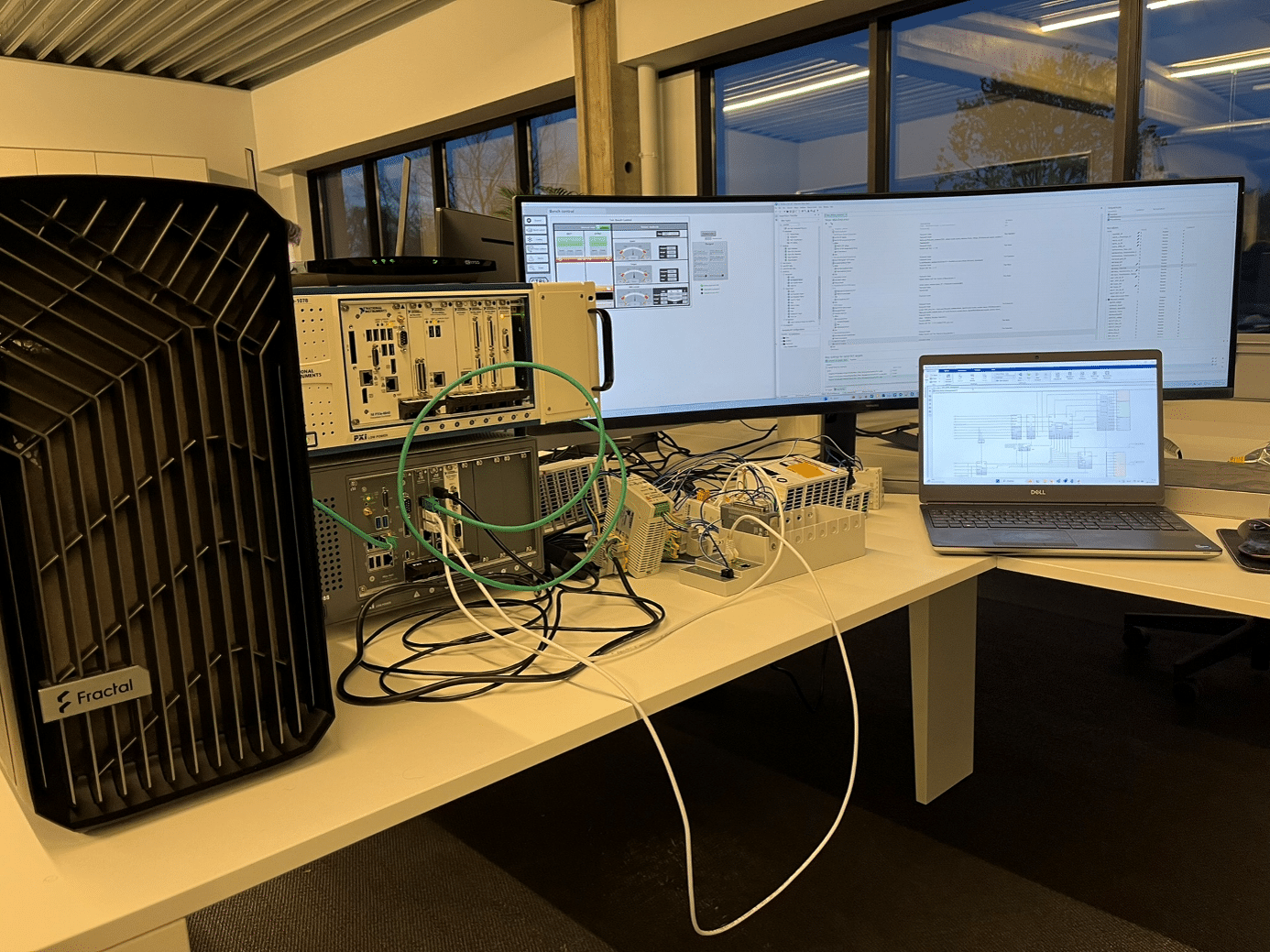
CTRL Engineering developed a test bench combining physical motor testing with a simulated vehicle environment. At the heart of the solution is an NI PXI real-time platform, with hardware and software supplied by CN Rood.
NI PXI and VeriStand: Real-time simulation and control
The system is built around an NI PXIe-8842RT real-time controller and PXIe-1088 chassis, running NI VeriStand. Operating at a 1 kHz control frequency, the platform executes eight interconnected Simulink models for advanced motor control.
These models generate realistic speed and torque setpoints and manage the different operating modes, drive commands, inverter control, feedback and safety procedures.
CTRL Engineering developed the models in MATLAB/Simulink and deployed them to the NI real-time target using Simulink Coder and VeriStand Model Generation Support. This makes it possible to update and reload individual models as motor configurations and test requirements evolve.
NI hardware: Connecting the complete test bench
The PXI platform acts as the real-time master, coordinating communication between the different systems and measurement devices.
The NI hardware includes:
- NI PXIe-8510: CAN/LIN communication with the motor inverter.
- NI PXIe-8245: Interface to the HBM GEN power analyser.
- NI 9205 and NI 9212: Analog input modules for temperature and other measurement signals.
- NI 9145: EtherCAT remote I/O platform.
- NI-XNET: High-performance CAN/LIN communication.
Integrating these components required coordination of multiple communication protocols. Three EtherCAT masters, CAN communication, and connections to a Beckhoff gateway PLC bring the drives, power electronics, cooling circuits and measurement equipment together. Modbus TCP and RTU interfaces provide additional communication with auxiliary equipment.
A dedicated heartbeat mechanism connects TestStand, VeriStand, the gateway PLC and the safety PLC. If communication is interrupted, predefined safety procedures are initiated.
NI TestStand and LabVIEW: Automated testing and operator control
The software architecture combines three NI tools:
- NI VeriStand handles real-time model execution, I/O, data logging and alarms.
- NI TestStand manages automated test sequences and report generation.
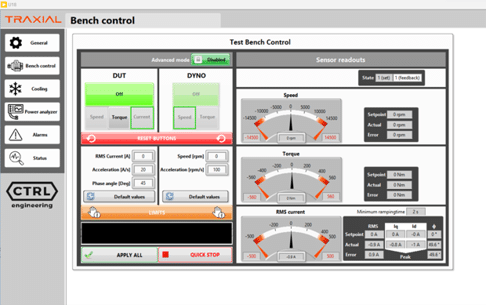
- NI LabVIEW provides the operator interface for manual control and system monitoring.
Together, these tools create a flexible testing environment in which operators can execute automated procedures or control and monitor the test bench manually.
Through the collaboration with CN Rood, CTRL Engineering could build on the NI hardware and software ecosystem to integrate simulation, real-time control and automated testing into one coherent platform.
The result
Faster validation and fewer physical prototypes
The new test bench enables Traxial to evaluate its electric motors under representative vehicle operating conditions without requiring a complete vehicle integration.
By combining real-time simulation with physical motor testing, engineers can investigate motor performance under different loads, validate designs and accelerate development iterations.
The project has delivered measurable benefits:
- 3x faster iteration towards product validation.
- 50% fewer prototypes, reducing development costs and hardware requirements.
- Reduced testing time through automated and repeatable test procedures.
- Shorter time to market, accelerating the development and validation process.
- Beyond these immediate results, the test bench provides a flexible platform for future motor development and testing.
The project demonstrates how NI PXI hardware and software can bring simulation and physical testing together in a single real-time environment. Through the collaboration between CTRL Engineering and CN Rood, Traxial now has the testing capabilities needed to validate its electric motor technology more efficiently and move faster towards the next generation of electric mobility.
All pictures in this article are property of TRAXIAL
Want to know more?
Ask one of our experts





Dennis Motshagen
Account Manager & Application Engineer


Contact
