

Project
Advancing mm wave research with flexible 5G and 6G prototyping at ULB
Summary
Organisation: Université Libre de Bruxelles (ULB)
Challenge: Proof of concept development in telecommunications at millimeter wave frequencies above 20 GHz
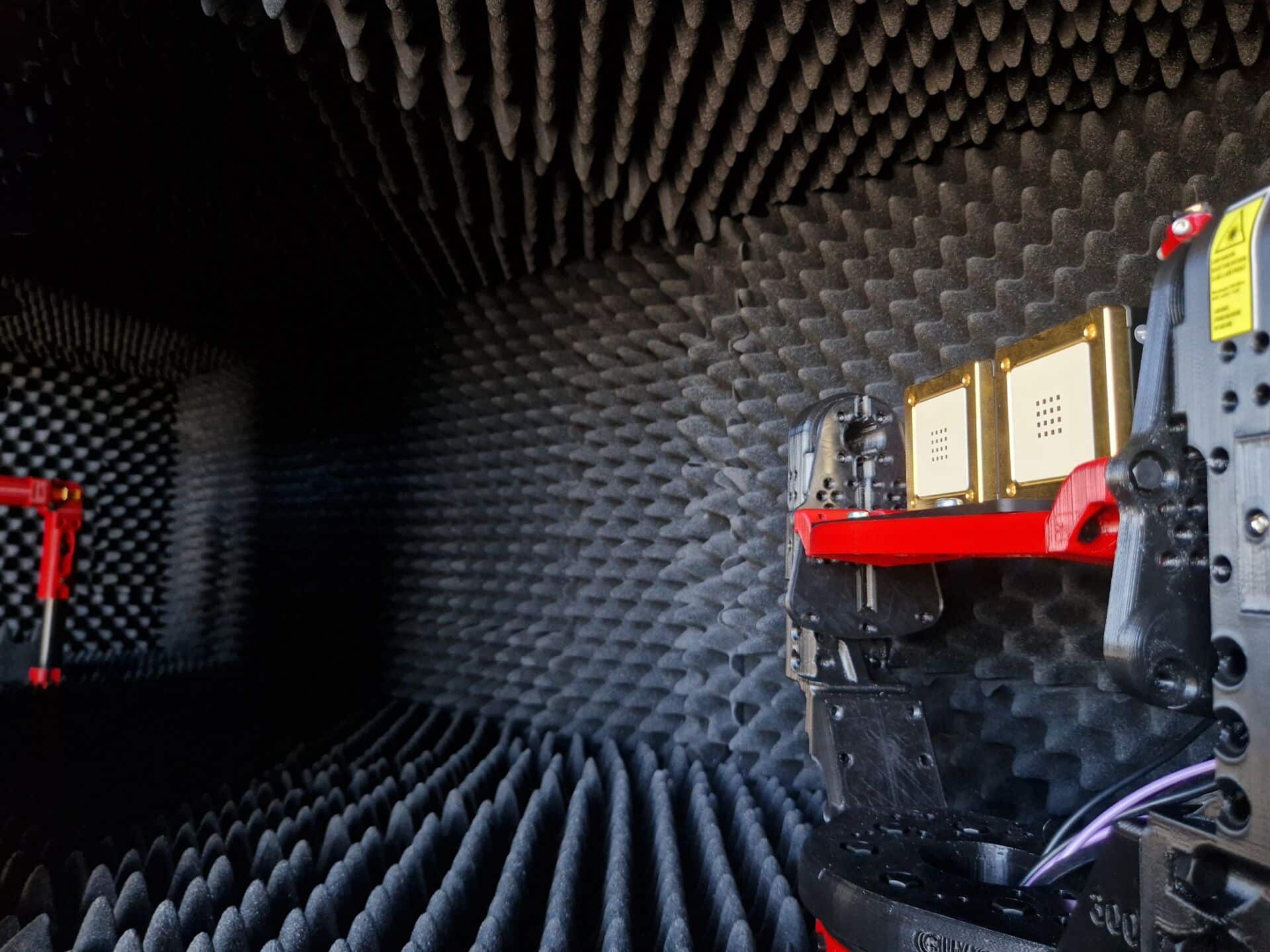
Solution: CN Rood delivered a flexible measurement setup based on solutions from TMYTEK and NI. The setup consists of four up and down converters and eight phased antenna arrays, enabling a highly configurable mm wave testbed.
At the Université Libre de Bruxelles (ULB), the research group led by François Quitin focuses on cutting edge challenges in telecommunications. Their work spans 5G and 6G systems, mm wave communication, industrial communications and radar technologies. A key strength of the group lies in proof of concept prototyping, where advanced theoretical ideas are translated into practical, real world implementations. By combining deep theoretical expertise with hands on experimentation, the team accelerates innovation in next generation wireless systems.

The challenge
Making mm wave research accessible and flexible
While proof of concept development in telecommunications has become more accessible thanks to software defined radios, working at millimeter wave frequencies above 20 GHz remains a major challenge. Hardware at these frequencies is typically complex and expensive, limiting flexibility for experimental research. The ULB team needed a solution that would allow them to rapidly prototype and validate advanced signal processing techniques in realistic mm wave environments, while maintaining full control over system configurations.
Photo: François Quitin, Associate Professor at Université libre de Bruxelles
The solution
A versatile mm wave experimental testbed
To overcome these challenges, CN Rood delivered a flexible measurement setup based on solutions from TMYTEK and NI. The setup consists of four up and down converters and eight phased antenna arrays, enabling a highly configurable mm wave testbed. This allows the research team to explore a wide range of applications, including hybrid beamforming transceivers, localization systems, and multistatic radar configurations.
The platform supports experimentation across multiple layers of the communication system, from signal processing to analog hardware and antenna design. Its unique flexibility gives researchers full control over system parameters and enables the development and testing of innovative communication architectures that are not yet available on the market.
The result
Validated research and a trusted collaboration
The implemented setup has played a key role in validating theoretical research through real world measurements. By enabling experimental verification, the system has strengthened the impact of ULB’s scientific contributions and supported numerous research outcomes in advanced wireless communications.
The collaboration with CN Rood has been an important factor in this success. As François Quitin notes, CN Rood “has been a valuable and reliable partner in our hardware acquisitions, with timely and insightful expertise.” With the right tools and support in place, ULB is well positioned to continue pushing the boundaries of 5G and 6G research.
Want to know more?
Ask one of our experts






Contact
