03-11-2026
5 minute read
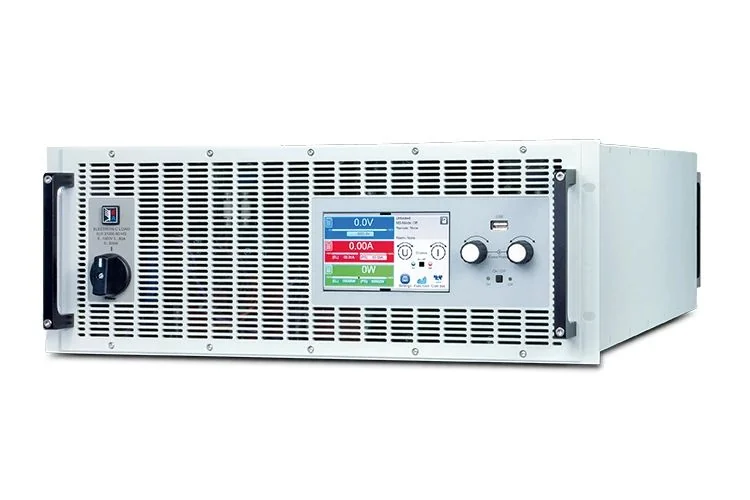
Tektronix has announced the EA-ELR 21000 Dynamic Test System, an auto-ranging, high-dynamic electronic load test system built on a fully regenerative architecture for validating the ±400-volt and 800-volt DC power architectures emerging in AI data centers. Rather than dissipating absorbed test energy as heat, the system returns it to the grid with up to 95% regenerative efficiency, helping manufacturers conduct sustained high-power validation with less demand on lab power and cooling infrastructure. The system is built around the new EA-ELR 21000-80 4U HS, a 30-kilowatt regenerative electronic load module rated for up to 1,000 volts and up to 80 amps.
AI compute demand is reshaping data center power from the grid connection to the rack. As computing density rises, manufacturers are moving toward ±400-volt sidecar designs and 800-volt DC distribution to reduce current conversion losses and the amount of copper needed to move power through the facility. At the same time, AI workloads create rapid, substantial changes in power demand that propagate through power shelves, power racks and infrastructure.
For engineers developing this infrastructure, testing at higher power is only part of the challenge. They must reproduce fast-changing load conditions, evaluate stability and conversion performance at system voltage, and sustain demanding test programs without requiring proportionate increases in facility power, cooling and floor space.
EA-ELR 21000
“AI is making power architecture a strategic design decision,” said James Hitchcock, Vice President and General Manager of the EA Portfolio at Tektronix. “The systems built for earlier generations of compute were not designed for the scale or pace of today’s AI workloads, and power systems can no longer be treated as one-size-fits-all. The opportunity is to design and validate more efficient, resilient power architectures for the AI infrastructure being built today, with test systems that can keep pace with the speed and scale of the change.”
Traditional high-power test approaches can force teams to choose between recreating fast-changing load behavior and managing the heat, cooling and grid demands of dissipative testing. Drawing on EA’s longstanding expertise in ultra-high-power programmable DC test systems, the EA-ELR 21000 system combines high-dynamic load emulation with a fully regenerative architecture in one coordinated system.
That combination changes what is practical in the lab. High-dynamic load emulation helps engineers expose voltage droop, recovery and stability issues before power infrastructure reaches the data center. Its fully regenerative architecture helps them sustain those tests at high power, with the AC input primarily supporting system losses rather than full peak test power.
The EA-ELR 21000 Dynamic Test System delivers:
The EA-ELR 21000-80 4U HS is rated for up to 1,000 volts, 80 amperes and 30 kilowatts in 4U, giving teams the voltage headroom needed to evaluate 800-volt DC power architectures. Integrated waveform generation supports repeatable load profiles, while coordinated controls enable multiple loads to operate as one synchronized test system. The modular architecture also lets teams add capacity as requirements evolve and service individual modules without disrupting the entire system.
The EA-ELR 21000 is designed for power shelves and power racks supporting 800-volt DC distribution, as well as solid-state transformers that convert medium-voltage AC power for high-power DC infrastructure. It gives manufacturers a way to evaluate dynamic behavior, stability, conversion efficiency and long-term reliability before those systems are deployed in AI data centers.
Later this fall, Tektronix will introduce the EA-ELR 20080-1000 4U HS, an 80-volt, 1,000-ampere regenerative electronic load module designed to help engineers validate the 48- to 54-volt rail that carries high current closer to AI compute. Part of Tektronix’s ongoing innovation in high-power test, the module will help ensure engineers have the right tools for the next major conversion stage in the AI data center power path.
03-11-2026
26-10-2026
14-10-2026

06-10-2026