07-04-2026
Blog: Astra Baltayan, EXFO
4 minute read
Until recently, most optical transceivers relied on direct detection technology, which measures only the amplitude of an optical signal. This approach is simple and effective for short-haul links, client interfaces, and data centers, but it struggles with noise and signal degradation over longer distances. Modulation formats such as NRZ (PAM2) and PAM4 transmit data efficiently over short links, but their limitations become apparent in long-haul networks. That’s where coherent transceivers step in.
A coherent transceiver is an advanced optical module that combines high-speed lasers, sophisticated digital signal processing (DSP), and advanced modulation techniques to transmit and receive data over long distances with high reliability and optimized spectral efficiency. By leveraging phase shift keying (PSK), quadrature amplitude modulation (QAM), and polarization multiplexing, coherent optical transceivers can overcome fiber impairments such as chromatic dispersion and polarization mode dispersion, maintaining signal integrity across hundreds of kilometers.
A coherent optical transceiver includes a tunable laser, a modulator, and polarization management. The laser generates a precise light wavelength that is encoded with data using phase and amplitude modulation. Polarization multiplexing doubles the transmission capacity by encoding separate data streams on orthogonal polarizations.
At the receiver, a local oscillator laser performs coherent detection, combining the incoming signal with a reference beam. The DSP then reconstructs the original data, compensating for impairments along the link. This ensures signal integrity over long-haul links, dense wavelength-division multiplexing (DWDM) systems, and data center interconnects (DCIs).
As coherent optics continue to evolve, new transceiver standards are addressing everything from short-reach enterprise and edge networks to long-haul metro and core applications.
Standards defined by the Optical Internetworking Forum (OIF), including 100ZR, 400ZR, and 800ZR, ensure interoperability and reliable performance.
100ZR and 100ZR+ bring coherent optics into shorter-reach environments where PAM4 falls short—such as enterprise networks, edge data centers, and 5G xhaul. 100ZR is optimized for connections up to 10 km, while 100ZR+ extends the reach to between 40km and 120 km, filling the gap between short-reach direct-detect solutions and longer-distance 400ZR deployments.
400ZR supports unamplified point-to-point links up to 80 km, making it ideal for data center interconnects (DCI) and metro networks. Meanwhile, 800ZR raises the bar—offering up to 800 Gbit/s in compact QSFP-DD and OSFP form factors—and ZR+ pushes the reach even farther for longer-distance deployments.
Deploying coherent optical transceivers isn’t a simple matter. Because coherent optics use advanced modulation formats like QPSK and 16-QAM, along with DSP-based compensation, precise validation is needed to ensure they deliver error-free, high-speed transmission in real-world networks. That’s where testing becomes critical—especially as AI-driven workloads accelerate bandwidth demands and raise performance expectations to unprecedented levels.
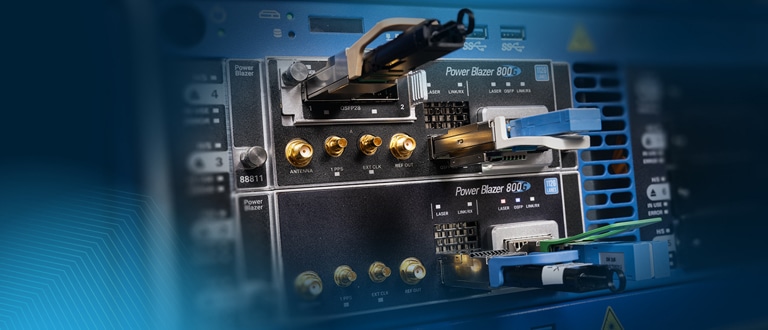
EXFO offers a full range of test solutions purpose-built for coherent optics, covering standards such as 100ZR, 400ZR and 800ZR.
As networks demand ever-higher speeds and longer reach, mastering coherent optical transceivers is essential. With advanced testing solutions, operators can deploy 100G, 400G, and 800G networks confidently, ensuring robust performance and future-ready optical infrastructure.
07-04-2026
31-03-2026
25-03-2026

24-03-2026

